

Travel.State.Gov >
International Travel > Learn About Your Destination > Cuba International Travel Information

Updated to reflect information on power grid failures and Department of the Treasury Office of Foreign Assets Control (OFAC) licenses for travel.
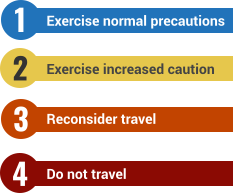
Exercise increased caution in Cuba due to crime and unreliable electrical power.
Country Summary: Petty crime is a risk for travelers in Cuba. This includes pick pocketing, purse snatchings, and car break-ins. Violent crime, including armed robbery and homicide, is also on the rise in Cuba.
U.S. law and regulation prohibit travel to, from, or within Cuba for tourist activities. OFAC regulates travel to, from, and within Cuba by persons subject to U.S. jurisdiction, defined to include, among other things, all U.S. citizens or residents (wherever located) and anyone in the United States, regardless of their citizenship and nationality. Failure by a person subject to U.S. jurisdiction to act consistently with the regulations may result in penalties and criminal prosecution. Travel to Cuba without an OFAC license is illegal.
Cuba's electrical supply is unreliable. Since October 2024, there have been several prolonged nationwide power outages. Scheduled and unscheduled power cuts lasting up to 12 hours occur daily in Havana, and even longer outside the capital. Some large businesses, hotels, hospitals, and institutions use generators during power outages. However, they may have trouble keeping the generators running during a long outage due to the inconsistent and scarce availability of fuel.
U.S. citizens in Cuba or those planning to visit should check local news often to stay up to date. In Cuba, peaceful assembly and freedom of speech are not protected rights. U.S. citizens should avoid protests or demonstrations.
U.S. Embassy employees must follow a special notification process with the Government of Cuba to travel outside of Havana. This process can impact the embassy's ability to help U.S. citizens in Cuba during emergencies.
If a person subject to U.S. jurisdiction travels to Cuba consistent with 1 of the 12 travel categories authorized by a general OFAC license, the person would not need to apply for a specific OFAC license for the travel transactions. For non-tourist travel that is not otherwise covered by a general license, a person subject to U.S. jurisdiction must seek a specific license from OFAC to authorize the travel. For travel questions, check 31 C.F.R. 515.560 and OFAC’s Frequently Asked Questions.
Read the country information page for additional information on travel to Cuba.
If you decide to travel to Cuba:
We highly recommend buying insurance before you travel. Check with your travel insurance provider about evacuation assistance, medical insurance, and trip cancellation coverage.
6 months beyond arrival date.
Two pages are required for entry/exit stamps.
Yes, for a variety of short-term travel purposes. Travel to Cuba for tourist activities remains prohibited by U.S. statute. Review the Trade Sanctions Reform and Export Enhancement Act of 2000 (TSRA) 22 U.S.C. 7209 ,the Cuban Assets Control Regulations (31 C.F.R. 515.560) and OFAC's Frequently Asked Questions.
None. See CDC for recommendations.
U.S. credit and debit cards do not work in Cuba. You should bring U.S. dollars or euros to Cuba and exchange them for Cuban Pesos (CUP) at authorized banks, CADECA (official currency exchange houses) offices, airports, or hotels. Travelers should confirm alternative payment options before traveling because Cuban policies concerning the use of U.S. dollars in Cuba may change. The Cuban government requires that travelers declare cash amounts over the equivalent of $5,000.
When departing Cuba, we advise U.S. travelers to spend or exchange CUP to a foreign currency before reaching airport security checkpoints. CADECA in the departure area at airports are currently open and CUP cannot be converted outside Cuba. International airlines flying to the United States include departure fees and taxes in the price of airline tickets. U.S. dollars are not accepted for payment by airlines for additional fees (baggage fee or other airline service charges) purchased at the airport. Each airline handles payment of fees differently; for example, some airlines require fees to be paid with a local currency credit card, and others use a local mobile app. Under Cuban law, travelers may take up to the equivalent of $5,000 out of the country. To depart with more cash than this, a traveler must show that the currency was acquired legitimately from a Cuban bank.
U.S. Embassy
Calzada between L and M Streets,
Vedado,
Havana, Cuba
Telephone: + (53) (7) 839-4100 (Monday- Friday 0830-1630, except holidays)
Emergency after-hours telephone: + (53) (7) 839-4100 and dial 1 to speak with the emergency operator
Fax: + (53) (7) 839-4247
Website: https:cu.usembassy.gov
Email: [email protected] (for concerns with U.S. citizens)
See the Department of State’s Fact Sheet on Cuba for information on U.S.-Cuba relations.
The Office of Foreign Assets Control (OFAC) of the U.S. Department of the Treasury regulates travel to and from Cuba for all persons under U.S. jurisdiction. Persons subject to U.S. jurisdiction for purposes of the OFAC regulations include, among others, U.S. citizens or residents anywhere and any person within the United States. For travel covered under the 12 travel categories authorized by a general OFAC license, you do not need to obtain a license from OFAC for the travel-related transactions. For travel not covered by a general license, you must seek OFAC authorization in the form of a specific license to authorize the travel. Travelers who fail to comply with regulations may face penalties and criminal prosecution. For travel-specific questions, please see 31 C.F.R. 515.560 and OFAC’s Frequently Asked Questions.
Check the CDC’s website on Cuba for immunization information.
Visit the Embassy of Cuba website for the most current visa information.
Cuba requires visitors to have non-U.S. medical insurance, which is usually included in airline ticket prices on flights originating in the United States. If you do not have insurance, it can be purchased upon arrival to Cuba at an airport kiosk. Asistur Medical Insurance is the official company that airlines contract. Please confirm your coverage with your airline prior to arrival in Cuba and seek additional medical insurance if needed.
Cuba does not recognize the U.S. citizenship of Cuban-born U.S. citizens who maintain residency status in Cuba. The Cuban government requires Cuban dual nationals to enter and depart Cuba using Cuban passports. Cuban-born U.S. citizens who maintain their residency status in Cuba will be treated as Cuban citizens by the government of Cuba and may be subject to Cuban restrictions and legal obligations. Under U.S. law, all U.S. citizens must enter the United States with their U.S. passport and must carry their U.S. passport when traveling to Cuba.
HIV/AIDS Restrictions: There are no HIV/AIDS entry restrictions for visitors to and foreign residents of Cuba. Foreign students on scholarships must test for HIV/AIDS. Please verify this information with the Embassy of Cuba before you travel.
Information about dual nationality, the prevention of international child abduction, and customs regulations can be found on our websites.
Cuban Requirements for Authorized Travelers: Attempts to enter or exit Cuba illegally, or to aid the irregular exit of Cuban nationals or other persons, are prohibited. Entering Cuban territory, territorial waters, or airspace without prior authorization from the Cuban government may result in arrest. Immigration violators are subject to prison terms ranging from four to thirty years.
Temporary Sojourn License: Most aircraft and maritime vessels on temporary sojourn to Cuba are not eligible for an Aircraft, Vessels, and Spacecraft (AVS) License Exception. See 15 C.F.R. § 740.15. If you are planning to enter Cuba with a U.S. or foreign-registered aircraft or maritime vessel on temporary sojourn, you must meet the criteria set forth in 15 C.F.R. § 740.15. Please see the U.S. Department of Commerce’s Bureau of Industry and Security website for additional information.
In addition, a vessel of the United States, as defined in 33 C.F.R. §107.200, requires a permit from the U.S. Coast Guard to enter Cuban territorial waters. ALL COMPLETED APPLICATIONS SHOULD BE EMAILED TO [email protected] or Fax to 305-415-6791 or call 305-415-6820. Please allow a minimum of 2 weeks for approval and processing of the permit.
Cuba’s security environment is relatively stable and characterized by military and police presence. Demonstrations are infrequent but can draw violent responses from government forces. Even peaceful demonstrations can turn confrontational without warning. Avoid demonstrations and always maintain security awareness. Demonstration Alerts are posted on the Embassy’s website. Review the Cuba Travel Advisory.
The Cuban government has detained U.S. citizens suspected of engaging in activities perceived to undermine state security. The Cuban government may detain individuals for activities not considered criminal or offensive in the United States.
Crime: Deteriorating economic conditions have led to an increase in crime. Crimes of opportunity, such as pick pocketing, purse snatchings, and car break-ins, are becoming more frequent and confrontational. Violent crime is on the rise, including robbery with weapons, assault, and home invasion. Exercise vigilance everywhere. Do not display large amounts of cash. Do not leave your valuables unattended. Carry money in your front pockets, hold your purse and cellular phone securely, and be mindful of purses or bags when dining out.
Scams: Internet romance and financial scams are prevalent in Cuba. Review the Department of State’s Tips to Protect Yourself from Scams and the FBI pages for information.
Technology Usage Abroad: There is no expectation of privacy in Cuba. Mobile devices can be compromised, stolen, or damaged anywhere in the world. Before traveling abroad, it is best to keep all software (operating system and apps) updated. If possible, use a virtual private network (VPN) and encrypted voice over IP (VoIP) applications. Make sure that all VPN/VoIP are reputable, and U.S. based. Do not connect to unknown open Wi-Fi.
GPS Navigation Apps are helpful in getting U.S. citizens around in a foreign country. Prior to using the GPS app make sure you research the route to make sure it is safe. GPS navigation apps may give you the shortest route without safety consideration. Due to limited internet access in Cuba, downloading an offline map is recommended. Stand-alone GPS devices are not allowed in Cuba.
Dating Apps: Be careful when using dating apps or online dating websites while abroad. Scammers may target U.S. citizens. Tell your friends and family where you are, meet in a popular public place, and avoid consuming suspicious food or drinks. Avoid traveling alone to bars or nightclubs.
Victims of Crime: U.S. citizen victims of sexual assault are encouraged to contact the U.S. Embassy for assistance.
Report crimes to the local police by dialing 106 and contact the U.S. Embassy at +53 7839-4100. Local authorities are responsible for investigating and prosecuting crimes.
See our webpage on help for U.S. victims of crime overseas.
We can:
Domestic Violence: U.S. citizen victims of domestic violence are encouraged to contact the Embassy for assistance.
Infrastructure: Cuba's electrical supply is unreliable. Since October 2024, there have been several prolonged nationwide power outages. Scheduled and unscheduled power cuts lasting up to 12 hours occur daily in Havana, and even longer outside the capital. Some large businesses, hotels, hospitals, and institutions use generators during power outages. However, they may have trouble keeping the generators operating during long outages due to the inconsistent and scarce availability of fuel.
Tourism: The tourism industry is not well regulated. Safety inspections of equipment and facilities are rare. Dangerous areas/activities are not always labeled properly. Staff may not be trained or certified by the host government or recognized authorities. If you get injured, you will likely only find appropriate medical treatment in or near major cities, and it may be substandard, as equipment and medical supplies are often unavailable. First responders cannot reach areas outside of major cities to provide urgent medical treatment. U.S. citizens are encouraged to purchase medical evacuation insurance and should maintain health insurance in Cuba. If stays exceed 30 days, U.S. citizens should purchase medical insurance when they process their visa extensions. Review our webpage for more information on insurance providers for overseas coverage.
Criminal Penalties: You are subject to local laws. If you break local laws, even if you don’t know it, you can be kicked out of the country, arrested, or put in prison. If you want to start a business or work in a job that needs special permits or licenses, you should get information from the local authorities before you start.
Furthermore, some laws are also prosecutable in the United States, regardless of local law. For examples, see our website on crimes against minors abroad and the Department of Justice website.
Arrest Notification: If you are arrested or detained, ask police or prison officials to notify the U.S. Embassy immediately. See our webpage for further information.
The Government of Cuba does not recognize the U.S. citizenship of Cuban-born U.S. citizens who maintain residency in Cuba and may not allow U.S. consular access to Cuban American prisoners.
Cuban penalties for the following are particularly severe:
Telecommunications: Many U.S. mobile service carriers provide roaming services in Cuba. Your U.S. mobile phone will work in Cuba if your mobile phone is capable of roaming in Cuba and your mobile service provider has an international roaming agreement with ETECSA, Cuba's state-owned telecommunications provider. Currently AT&T, Verizon, and T-Mobile have roaming agreements with ETECSA. Wi-Fi is often slow and unreliable. Be sure to confirm your carrier’s coverage before traveling.
SIM cards with a data plan can be purchased at Havana-José Martí International Airport (HAV) and local ETESCA telecommunications offices. To ensure family and friends can reach you in Cuba, check with your mobile provider about roaming options and cost or purchase a Cuban SIM card.
Cuba-related Travel Transactions: Only persons whose travel falls into the 12 OFAC approved travel categories or who have received a specific license from OFAC are authorized by the U.S. Department of the Treasury to travel to, from, or within Cuba. Direct financial transactions with certain entities and sub-entities under the control of, or acting for or on behalf of, the Cuban military, intelligence, or security services are also generally prohibited. For more information see the Department of State’s Cuba Restricted List. Additionally, lodging, paying for lodging, or making reservations on behalf of others to lodge, at certain accommodations in Cuba are prohibited; for a full list of such accommodations, see the Cuba Prohibited Accommodations List. For more information about regulations and licenses, visit OFAC’s Cuba Sanctions website.
Licenses for Remittances: OFAC regulations impose no cap on remittances to family members in Cuba and authorize remittances to non-family recipients as well. Certain Prohibited Officials of the Government of Cuba, Prohibited Members of the Cuban Communist Party, and the close relatives of these two groups, are not eligible to receive remittances. For information on remittance authorizations, see OFAC’s Cuba Sanctions website.
What May Be Brought Back from Cuba: Importation of Cuban merchandise for commercial purposes is restricted, with very limited exceptions. Certain imports of goods produced by independent Cuban entrepreneurs are authorized, as set forth on the Department of State’s Section 515.582 List (see 31 C.F.R 515.582). There are no limits on the import or export of informational materials. For more information related to imports, including merchandise entering the United States for personal use as accompanied baggage, please see the CBP Public Notice.
Cuban law requires foreigners to obtain authorization to remove souvenir paintings and sculptures out of Cuba. Most authorized points of sale, such as galleries and art studios, should know this process and should provide the proper documentation at purchase. You can also apply for an export permit via the Cuban Fund of Cultural Assets. Travelers without a valid export permit may have their items confiscated at the port of departure. The U.S. Embassy cannot assist in these cases. For more information, please contact the Embassy of Cuba.
Travelers may purchase alcohol and tobacco products while in Cuba for personal consumption in Cuba but may not enter the United States with alcohol or tobacco products acquired in Cuba.
Persons subject to United States jurisdiction may purchase or acquire Cuban-origin merchandise for personal consumption while in a third country, but may not import Cuban-origin alcohol or tobacco products into the United States, even for personal consumption. For a complete description of what this general license authorizes and the restrictions that apply, see 31 CFR § 515.585(c) and (d).
Counterfeit and Pirated Goods: Counterfeit and pirated goods are prevalent in many countries. They may be illegal according to local laws. Counterfeit and pirated goods may pose significant risks to consumer health and safety. You may be subject to fines and/or have to give up counterfeit and pirated goods if you bring them back to the United States. See the U.S. Customs and Border Protection website and U.S. Department of Justice website for more information.
Storm Season: Tropical storms and hurricanes between May and November can produce heavy winds and rain. See our page on disaster and crisis preparedness for more information.
Faith-Based Travelers: See the following webpages for details:
International Volunteers:
Gay and Lesbian Travelers: There are no legal restrictions on same-sex sexual relations or the organization of Gay and Lesbian events in Cuba. Same-sex marriage has been legal since 2022.
See our Gay and Lesbian Traveler Information page for further details.
Travelers with Disabilities: The law in Cuba prohibits discrimination based on disability, however registering complaints to the Cuban government is often ineffective. Havana's older infrastructure presents challenges for individuals with mobility needs. Expect accessibility to be limited in public transportation, lodging, communication/information, and general infrastructure. Many attractions and cultural sites, especially museums, are not well-equipped for people with mobility considerations, and wheelchair users may find cobblestone streets, especially in older areas, challenging. Accessibility for individuals with disabilities outside of Havana is very limited. Accessibility can be further impacted by a shortage of assistive devices and frequent power outages.
See our Travelers with Disabilities page.
Students: See our Students Abroad page and FBI travel tips.
Women Travelers: See our travel tips for Women Travelers.
Currency Restrictions: Be advised that policies concerning the use and convertibility of U.S. dollars in Cuba are subject to change. Obtaining U.S. dollar cash is nearly impossible through official channels. The Cuban Central Bank prohibits certain U.S. dollar cash transactions, including conversion of U.S. dollars to Cuban pesos, the use of U.S. dollars for cash payments, including in government-run establishments such as hotels and restaurants, and the purchase of pre-paid debit cards. U.S.-issued credit and debit cards do not work in Cuba. Travelers should bring sufficient cash for the duration of their trip, and consider bringing multiple currencies, such as euros.
For emergency services in Cuba, dial:
Ambulance services are
Injured or seriously ill travelers may prefer to take a taxi or private vehicle to the nearest major hospital rather than wait for an ambulance.
See our Health Abroad page for more information.
The Department of State, U.S. embassies and U.S. consulates do not pay medical bills. Be aware that U.S. Medicare/Medicaid does not apply overseas. Hospitals and doctors in Cuba do not accept U.S. health insurance. Most hospitals require payment up front before services are rendered.
Medical Insurance: Ensure your airline ticket includes health insurance. Cuba requires all U.S. airlines departing the United States to pay for health insurance for each passenger. The health insurance from airlines is valid for 30 days upon your arrival in Cuba. If you are planning to stay in Cuba for more than 30 days, you will need to extend your coverage before you can extend your visa. It is important to keep a record of your arrival into Cuba, such as your airline ticket, so that the Asistur Medical Insurance agency can coordinate with the hospital on payment.
See our Insurance Overseas page for more information on insurance providers with overseas coverage. Visit the U.S. Centers for Disease Control and Prevention Travel Insurance page for more information on the type of insurance you should consider before you travel overseas.
Medical evacuation flights from Cuba are difficult to arrange, with costs starting at $15,000.
Ensure you have all medicine you require for your time in Cuba. Medicine (prescription and over the counter) is not available in Cuba. Due to the unavailability of pharmaceuticals in Cuba it is highly recommended that you bring insect repellant, sunscreen, anti-diarrheal medication, anti-bacteria creams, pain relievers (Ibuprofen, Acetaminophen), and any prescription medication. Always carry your prescription medication in original packaging. Check with the Embassy of Cuba to ensure the medication is legal in Cuba. Note: This site is in Spanish only.
Diarrheal illness is common among travelers, even in luxury accommodations. Travelers should wash their hands, drink bottled water, and avoid street and undercooked foods.
The following diseases are prevalent:
Vaccinations: Be up to date on all vaccinations recommended by the U.S. Centers for Disease Control and Prevention.
Further health information:
Air Quality: Air pollution is a problem in several major cities in Cuba. Consider the impact seasonal smog and heavy particulate pollution may have on you and consult your doctor before traveling if necessary.
Air pollution can be a significant problem in many destinations overseas.
The air quality varies considerably and fluctuates with the seasons. It is typically at its worst in the spring. People at the greatest risk from particle pollution exposure include:
The U.S. Embassy maintains a list of doctors and hospitals here. We do not endorse or recommend any specific medical provider or clinic.
Pharmaceuticals: Even the most common over the counter medications are not available in Cuba. Other medications, medical equipment, or supplies are also unavailable on the island. If you can find medicine, exercise caution when purchasing medication overseas. Counterfeit medication is common and may not work, have the wrong strength, or have dangerous ingredients. You should buy medication with the help of a medical professional and from trusted places.
U.S. Customs and Border Protection and the Food and Drug Administration have rules for bringing medication back to the United States. Medication bought abroad must meet their requirements to be legally brought back. The medication must be for personal use and approved for use in the United States. Visit the websites of U.S. Customs and Border Protection and the Food and Drug Administration for more information.
Water Quality: Tap water is not potable. Bottled water is often unavailable for purchase, and you should be aware that some restaurants and hotels serve tap water unless bottled water is specifically requested. Be aware that ice for drinks may be made using tap water.
General Health Issues: There are severe shortages of food, potable water, medicine, medical supplies, etc. throughout Cuba.
Road Conditions and Safety: Road accidents are Cuba’s leading cause of death. Many involve pedestrians and bicyclists. Cuban authorities may prohibit drivers from leaving the country until claims associated with an accident are settled. Drivers found responsible for accidents resulting in serious injury or death may receive long prison sentences. U.S. citizen drivers are often found at fault for accidents they are involved in.
Drive with extreme care. Major streets are generally well-maintained, but secondary streets are not. Major potholes and obstacles are common on all roads. Bridges can collapse after heavy rains. Damaged bridges may not be well marked.
Outside of major cities or during blackouts, avoid driving at night. Emergency lights or signals are rare, making it virtually impossible to detect hazards after dark. Street signage is insufficient and confusing. Many Cuban cars are old, in poor condition, and lack reliable safety equipment. Rolling blackouts may leave streets dark and without traffic lights, even in major cities.
The principal Cuban east-west highway is in good condition but extends only part of the way from Havana to the eastern end of the island. Hazards—including unfenced livestock and farm vehicles—are common.
When traveling by road, you should carry a printed map of the area, as electronic (smartphone) maps frequently fail due to connectivity issues.
Traffic Laws: Speed limits are sometimes posted. Passengers in automobiles must wear seatbelts, if available. Motorcyclists must wear helmets. Traffic from major roads generally does not stop when entering roundabouts. Use care at intersections: stop signs are often hard to see. If involved in a traffic accident in Cuba, you must report the incident to local authorities, and you should obtain a copy of the police report (called a ‘Comprobante de Denuncia’). You may be detained until the case is resolved, and depending on the severity of the accident, you may face legal consequences, including possible imprisonment if serious injuries or fatalities occur.
Public Transportation: Buses designated for tourist travel, both between and within cities, generally meet international standards.
The public bus and rail systems are in poor condition. Public buses used by Cubans, known as "guaguas," are crowded, unreliable, and are sometimes preyed upon by petty criminals. There is a heightened threat of pickpocketing on crowded buses and trains. Embassy personnel are advised to avoid public transportation.
Avoid using informal taxis or hailing private vehicles for rides as they are unregulated. The vehicles are often in disrepair and usually do not have normal vehicle safety equipment such as seat belts and air bags. “Cocos,” smaller, yellow ball-shaped “tuk-tuk” style vehicles, are not safe, and the Embassy advises its personnel not to use them.
Rental car agencies provide roadside assistance to their clients as a condition of rental contracts. Travelers should not permit unauthorized people to drive their rental vehicles.
See our Road Safety page for more information.
Aviation Safety Oversight: The U.S. Federal Aviation Administration (FAA) has not assessed Cuba’s Civil Aviation Authority for compliance with international standards for aviation safety oversight. FAA’s website includes more information on its assessment program.
The U.S. Embassy prohibits its employees from using any commercial airline for domestic flights within Cuba due to safety concerns. The Embassy prohibits its employees to travel via Cubana Airlines.
Maritime Travel: Mariners and passengers planning travel to Cuba should check for U.S. Maritime Advisories and Alerts. Information may also be posted to the NGA Navigational Warnings website. The U.S. Coast Guard determined Cuban ports do not have effective anti-terrorism measures. Vessels that arrive in U.S. ports from Cuban ports must meet additional U.S. Coast Guard conditions of entry as described in the current Port Security Advisory, International Port Security Program - Port Security Advisory. Mariners and passengers traveling through the ports of Cuba should exercise caution.
Review information about International Parental Child Abduction in Cuba. For additional IPCA-related information, please see the International Child Abduction Prevention and Return Act (ICAPRA) report.

Subscribe to get up-to-date safety and security information and help us reach you in an emergency abroad.
Recommended Web Browsers: Microsoft Edge or Google Chrome.
Check passport expiration dates carefully for all travelers! Children’s passports are issued for 5 years, adult passports for 10 years.
You are about to leave travel.state.gov for an external website that is not maintained by the U.S. Department of State.
Links to external websites are provided as a convenience and should not be construed as an endorsement by the U.S. Department of State of the views or products contained therein. If you wish to remain on travel.state.gov, click the "cancel" message.
You are about to visit: