- Crime (C)
- Unrest (U)
- Health (H)
- Natural Disaster (N)
- Kidnapping or Hostage Taking (K)
- Other (O)
Reissued after periodic review with minor edits.
Review the latest State Department Travel Advisory about Papua New Guinea. You can plan for safe travel by following the entry and exit requirements, reviewing local laws, and reading other travel guidance from the U.S. embassy or consulate
Visit pg.usembassy.gov
Learn more about U.S. and Papua New Guinea relations at State.gov
Learn more about Travel Advisory levels
to Papua New Guinea due to crime, civil unrest, and piracy. Exercise increased caution due to kidnapping, unexploded ordnance, inconsistent availability of healthcare services, and potential for natural disasters. Some areas have increased risk. Read the entire Travel Advisory.
Do not travel to:
Violent crime, including sexual assault, carjackings, home invasions, and armed robberies, is common. There have been reports of criminals attacking resorts popular with foreign tourists to steal goods and money. Tensions between communal or tribal groups may lead to civil unrest involving violence and can occur without warning. Police presence is limited outside of the capital, Port Moresby, and police may be unable to assist due to limited resources.
The U.S. government has limited ability to provide emergency services to U.S. citizens outside of Port Moresby due to limited transportation infrastructure. U.S. government employees must obtain authorization before traveling to certain areas, including the central part of Bougainville and the provinces of Southern Highlands, Western Highlands (excluding Mt. Hagen), Eastern Highlands (excluding Goroka), Hela, Enga, Jiwaka, and other areas of Papua New Guinea where one is unable to fly directly.
Piracy is active in the waters surrounding Papua New Guinea. Travelers by boat should reconsider travel to the Bismarck and Solomon Seas along Papua New Guinea's north and eastern coasts. In 2021 and 2022, the Embassy was aware of at least three occasions in which sailboats operated by or carrying U.S. citizens were boarded by criminals. The criminals, who have been known to use physical violence, robbed the boats, and in one incident, severely injured the captain when he attempted to fight back.
Visit our website on International Maritime Piracy and Armed Robbery at Sea.
Kidnapping for ransom or political influence occurs in Papua New Guinea, though foreign nationals are not frequently targeted. In February 2023, a foreign national was kidnapped. In late 2022, foreign nationals employed by an international company were kidnapped and held for several days.
Travelers should exercise increased caution when traveling in remote areas of Papua New Guinea due to the presence of unexploded ordnance (UXO) remaining from the Second World War. UXO is discovered infrequently throughout the country, often on smaller islands.
Papua New Guinea has inconsistent availability of healthcare services. Healthcare may be difficult to obtain outside of Port Moresby. Pharmaceuticals may be scarce or unavailable.
Papua New Guinea is subject to periodic seismic activity and is home to several active volcanoes. The country does experience regular volcanic eruptions, earthquakes, and tsunamis. U.S. citizens are advised to familiarize themselves with volcano updates, earthquake tracking, and tsunami warnings in Papua New Guinea. U.S. citizens should develop contingency plans in the event of an eruption or major earthquake.
Read the country information page for additional information on travel to Papua New Guinea.
Do not travel:
The Autonomous Bougainville Government has designated areas near the Panguna mine as a “no go zones" due to the risk of violence from civil unrest. Bougainville police lack the resources to respond to emergency calls.
Visit our website for Travel to High-Risk Areas. Do not travel to this area for any reason.
Do not travel:
There is a heightened risk of civil unrest from tribal violence throughout the region, including the provinces of Southern Highlands, Western Highlands, Eastern Highlands, Hela, Enga, and Jiwaka. The towns of Mt. Hagen (Western Highlands) and Goroka (Eastern Highlands) generally have a more stable police presence than other towns and villages across the Highlands provinces. Do not travel to this area for any reason.
Visit our website for Travel to High-Risk Areas.
Learn more about Travel Advisory levels
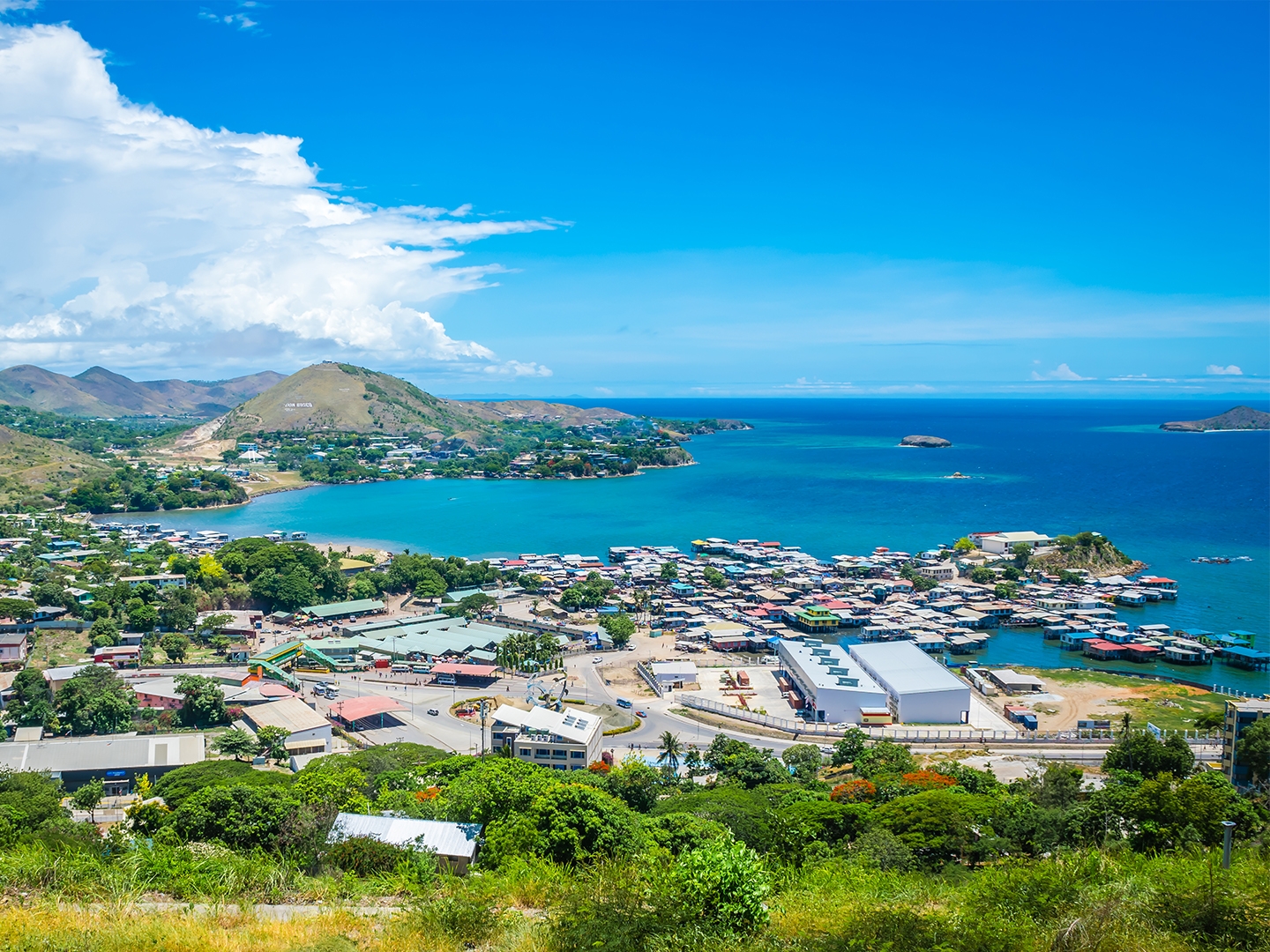
Papua New Guinea is a nation in Oceania, in the Southern and Eastern Hemispheres. It is made up of about 600 islands. Papua New Guinea shares a land border with Indonesia on its largest island and sea borders with Australia and Solomon Islands.
Papua New Guinea's landmass is approximately the size of California. There are two time zones, in the capital, Port Moresby, and in the Autonomous Region of Bougainville. The country does not observe daylight saving time. Port Moresby is 14 hours ahead of Washington, D.C. during Eastern Standard Time.
NOTE: The U.S. Embassy in Honiara, Solomon Islands does not currently provide routine or emergency services to U.S. citizens. Such services are provided by U.S. Embassy Port Moresby, Papua New Guinea.
Harbour City Road, Konedobu
P.O. Box 1492
Port Moresby, NCD 121
Papua New Guinea
Message failed to load
We are unable to load the message. Visit the main U.S. embassy or consulate website for updates.
Explore our travel guidance topics to prepare for your trip abroad.
Date issued: October 15, 2026
The Government of Papua New Guinea imposes HIV and AIDS entry restrictions for visitors and foreign residents.
If you request residency or plan to stay long term in Papua New Guinea, you must have an HIV and AIDS test performed at a U.S. medical facility.
Demonstrations are common. They may take place in response to political or economic issues. They may also occur on significant holidays and during large events.
Papua New Guinea has a high crime rate. Crimes occur everywhere.
Follow the Department of State guidelines to protect yourself from scams.
If you are a victim of a scam, learn how the FBI can help.
Financial scams and Internet romance scams are common in Papua New Guinea. Be careful of anyone asking for money, especially those who start a "romantic" relationship online or claim local authorities want money. Scams often begin through online posts, emails, or letters. Scammers sometimes pretend to be U.S. citizens in need of help. Common scams include:
If using dating apps or websites in Papua New Guinea:
Local authorities are responsible for investigating and prosecuting crime. You may report crimes to the local police by dialing 112.
U.S. citizen victims of sexual assault are encouraged to contact the U.S. embassy for assistance.
U.S. citizen victims of domestic violence are encouraged to contact the U.S. for assistance.
Mobile devices are vulnerable to compromise, theft, and damage anywhere in the world. Follow these safe practices:
You may need to register drones for commercial use or those above a certain weight with the Civil Aviation Authority.
Prior to using GPS abroad:
The tourism industry is unevenly regulated:
Review our information on Travel Insurance.
Recreational diving may be dangerous.
Exercise caution and common sense when engaging in all adventure sports, including but not limited to whitewater rafting, sea kayaking, and windsailing.
Exercise caution if you plan to hike the Kokoda Track, the Black Cat Track, Mt. Wilhelm, Mt. Giluwe, or other hiking trails in Papua New Guinea.
Counterfeit and pirated goods are common in many destinations.
Learn more about U.S. restrictions on counterfeit and pirated goods:
Faith based travel includes pilgrimages, service projects, and mission work. Prepare for your travel using these resources:
Same-sex sexual relations are illegal. The maximum penalty is 14 years in prison. This law is not often enforced. There have been reports of discrimination and violence against gay and lesbian people in recent years. Papua New Guinea is a conservative country. Avoid public displays of affection.
The law in Papua New Guinea prohibits discrimination against people with physical, sensory, intellectual, or mental disabilities. The law is rarely enforced.
Sexual assault and gender-based violence are common in Papua New Guinea.
Women should not travel alone.
Ambulance services are not widely available outside of Port Moresby and other major urban areas.
Make sure you know if your health insurance plan covers any medical expenses abroad. Most U.S. plans do not cover medical expenses abroad.
Stay up to date with the vaccines recommended by the U.S. Centers for Disease Control and Prevention.
Health facilities are generally limited or inadequate in Papua New Guinea.
Always carry your prescription medication in original packaging, along with your doctor’s prescription.
U.S. Customs and Border Protection (CBP) and the Food and Drug Administration (FDA) have rules for bringing medication back into the United States. If you buy medications abroad, the medications must meet CBP’s and the FDA’s requirements to bring them back legally.
The medications must also be for personal use and approved for use in the United States.
For more information:
Belief in sorcery and witchcraft (locally called "sanguma") is widespread in Papua New Guinea. Unexplained deaths, illnesses, or misfortunes are sometimes attributed to sorcery, which can trigger mob violence against accused individuals. U.S. citizens should be aware of the following:
If you are considering traveling to Papua New Guinea to have a child through use of assisted reproductive technology (ART) or surrogacy, please review our information on ART and Surrogacy Abroad.
Some areas of Papua New Guinea, such as the Highlands and the Kokoda Trail, are at high altitude.
Air pollution can be a significant problem in many destinations abroad.
Traffic in Papua New Guinea moves on the left. Police roadblocks are common and check vehicle registrations at night in Port Moresby. Police may not always act in a professional manner.
After a car accident, crowds of people can get upset and angry. Sometimes they react in unpredictable and dangerous ways.
Mariners and passengers planning travel to Papua New Guinea should check the following:
Papua New Guinea is among the most natural disaster-prone countries in the world. Be aware that natural disasters can occur at any time with little notice.
If you live outside the United States for a long time, you or your family may experience various life events, wish to exercise U.S. citizenship rights, or need to meet U.S. legal obligations while abroad.
NOTE: The U.S. Embassy in Honiara, Solomon Islands does not currently provide routine or emergency services to U.S. citizens. Such services are provided by U.S. Embassy Port Moresby, Papua New Guinea.
Harbour City Road, Konedobu
P.O. Box 1492
Port Moresby, NCD 121
Papua New Guinea
Reissued after periodic review with minor edits.
Invalid Input
Last Updated: October 15, 2026
Owned by Overseas Citizens Services
An official website of the Department of State - Bureau of Consular Affairs